Leading at the Decisive Point
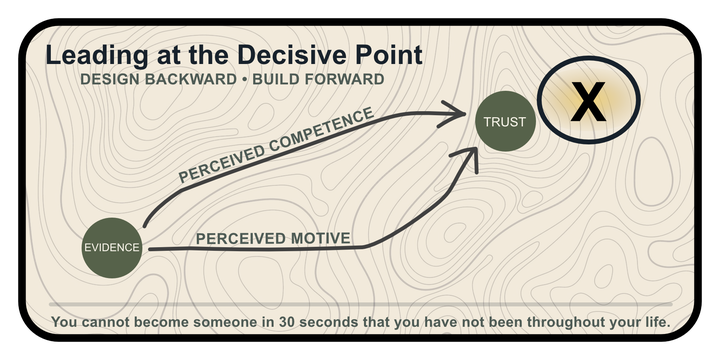
Leading at the Decisive Point: Starting from the endstate and working backwards toward leader behaviors.
We’ve all read the books and sat through the seminars. We’ve learned the models, the theories, and the four-quadrant charts that promise to make us better leaders. But what happens when the neat lines of those models collide with the messy, high-stakes reality of a true crisis and your life or those of your subordinates is on the line? What do you do when you’re in a ditch, the plan has fallen apart, and the people you lead are looking to you for a way forward when all options look grim? This is the decisive point in Leadership. It’s the moment where the outcome hangs in the balance and a leader’s actions will determine whether the team survives or breaks. In these moments, traditional leadership theories about motivation or transactional rewards often fall short. They weren’t built for this.
My journey to understanding this concept came from years of experience on the battlefield, followed by a deep dive into the science of leadership at West Point. I went from learning the art of leadership by emulating great leaders to studying the science of it through academic models. Yet, something was still missing. The models were helpful for organizational management in stable environments, but they couldn’t explain the dynamic I experienced one Christmas Eve in Iraq. Pinned down by enemy fire with a small team, I looked to my seasoned NCO. His response wasn’t a solution, but a simple, powerful statement: “I have no idea [what we should do], but we can’t stay here.” He then looked at me, ready to follow. Why? In that moment, he wasn’t evaluating my transformational leadership qualities or how effectively I used motivational theories. He was making a gut-level decision based on one thing: trust.
I had spent my early military career learning leadership through the art of emulation. I would look at someone I admired and try to figure out what made them tick and what made them successful. I eventually went on to earn my MBA at UNC, where I encountered scientific leadership models. Shifting from leading by instinct and emulation to being informed by frameworks that generally transcend context was a significant moment in my career. Seeking to better understand the science of leadership led be back to West Point where I taught PL300: Military Leadership–a flagship core-course that brings models grounded in the behavioral and organizational sciences to the nation’s future leaders of character. I learned through self-study, teaching, and reflection about understanding yourself, leading and motivating others, and building organizations. I went on to earn my PhD, studying leader development, character development, and intentional self-regulation.
Last year, I began teaching a course called Leadership in Combat. The course is designed to take our scientific understanding of leadership and apply it to a very specific context, In-Extremis and combat situations. None of the existing models really helped me frame or describe the situation in Iraq many years ago. Like all models, they were useful, but they were all wrong. They were simplifications of a very messy, complex reality. I realized that the models were missing the decisive point.
The decisive point, in military doctrine, is the point of no return. It is the point where we are going to win no matter what the enemy throws at us. We put all of our resources onto that one time, that one moment, and if we can concentrate our effort there, we will win the fight. The enemy doesn’t have a chance. But how do you know if you’re at such a decisive point? And more importantly, what makes leadership successful at that point? The answer, I came to understand, is trust. At the heart of the decisive point, when someone is either going to run out in the open and do something that could cost their life or cower back, the two things they care about with a leader are whether they are competent and whether they have their best interests at heart. Trust is formed via perceived competence and perceived motive, not credentials or rank alone.
In the military, we always conduct backward planning from the decisive point, often referred to as the “X” which is the doctrinal representation in military graphics. Figure out what we need to accomplish to maximize the chances of success, then work backwards from there. I also found that backwards planning from the decisive point is the key to understanding how to lead when much of the nice to haves are stripped away from leadership. No one cares about your title, your accomplishments, or your bank account when their lives are on the line. They only care about your competence and motive. The endstate for a leader is to have earned enough trust that your team will follow you, even when the path is dangerous and the outcome uncertain.
Most leadership models focus on behaviors that a leader should do to be considered good. Focusing on the endstate instead of behaviors (building trust through competence and motive) is something we work towards instead. The leader behaviors are actions that support the endstate, not actions to be done prescriptively to hopefully achieve an endstate. When lives are on the line, followers aren’t thinking about your charisma. They are subconsciously asking two fundamental questions: Are you competent? Do you have my best interests at heart? Keeping the endstate in mind as the superordinate goal, helps us craft leader development plans and behaviors that are actually effective.
Perceived Competence
Perceived competence is the first pillar. Competence isn’t just about having experience. For new leaders, it’s about demonstrating expertise. You can be an expert in the regulations, the technical systems, and the science of your field long before you have years of experience. It’s about showing up prepared. Competence is also perceived through discipline, presence, and humility. Discipline is doing the hard things no one wants to do–but you know should be done–like shining your shoes or preparing for a meeting when you could be doing something that you actually want to be doing. It signals your commitment. Presence is how you carry yourself, even when you don’t have all the answers. Humility is knowing what you don’t know and being willing to learn from failure. A leader can be the most competent person in the room, but if they never demonstrate it in front of their subordinates, they may not be perceived as competent.
Perceived Motive
Perceived motive is the second pillar, and it is the character component. Your team needs to believe that you are in it for them, not for your own self-preservation or glory. A leader with a selfish motive is the most dangerous person in an organization, especially if they are highly competent. You demonstrate a positive motive through connection, consistency, and self-sacrifice, in other words, your character. Connection means taking the time to know your people beyond the bio sheets. When you understand them as individuals–truly connect with them–they will give you the benefit of the doubt in a crisis. Consistency means your character must be the same on the front lines, in the office, and behind closed doors. People see everything, and your reputation is built on that consistency. Self-sacrifice means showing that you are willing to share in the hardship and put the team’s needs before your own.
You cannot build trust in the middle of a crisis. It must be earned every single day in the small moments. It’s built when you demonstrate your competence in a routine task, show genuine care for a team member’s well-being, and take responsibility for mistakes. As a leader, ask yourself every day: Did I build trust today? Did I demonstrate my competence and my care for my team? Did I let them see it? Leadership at the decisive point isn’t about having a magic solution. It’s about having done the hard work of building trust ahead of time, so that when the moment comes, your team is ready to move with you.
The leadership models and theories we study are all valuable tools for understanding leadership in stable, predictable environments. But they are not designed for the decisive point. They cannot tell you what to do when the plan has collapsed, when your team is looking to you for a way forward, and when the outcome hangs in the balance. At the decisive point, leadership is not a science to be applied. It is a practice to be lived. It is the willingness to stand in the gap, to earn the trust of those who depend on you, and to make the hard call when everything is on the line. That is what it means to lead at the decisive point.
Disclaimer: The views expressed are those of the author and do not necessarily reflect the official policy or position of the United States Military Academy, the Department of Defense, or the U.S. government.

Andrew G Farina
Academy Professor
My research interests include leadership (risk-taking propensity | appraisal) and character (intentional self-regulation) development.